
by Crane Wood Stookey
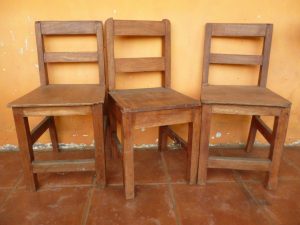
Our state of mind is generally pretty fickle, easily influenced by whatever we encounter. If we walk into a room full of little gilt chairs with white cloth covers tied over their backs, or into a room of stacking plastic chairs, or a room with random cushions and bean bags spread around, we feel different in each room as soon as we walk in. The chairs alone have the ability to influence our state of mind. When we try to create conditions that engage the people we want to work with, we miss an opportunity if we ignore the chairs.
One person who understood the importance of chairs was Nelson Mandela.
Mandela needed to make peace with General Viljoen, an Afrikaner who led the militant white resistance to change in South Africa. After some work through intermediaries, the general was willing to meet and talk. He expected this meeting to be with himself and his aides on one side of a conference table, Mandela and his aides on the other, with a lot of intense disagreement and animosity, possibly leading to some concessions on one side or another. Instead, Mandela invited the general to his own house. They sat next to each other in Mandela’s living room, and Mandela himself served the general tea. Their few aides waited in another room. Mandela spoke to the general in Afrikaans. By the end of the meeting the general had agreed to stop fighting.
Of course it wasn’t just the living room chairs. Nelson Mandela had an extraordinarily powerful personality and great skill with people. He was known for disarming opponents with his warm interest and genuine respect even in his prison cell, and he may well have achieved the same agreement with the general over a conference table.
But Mandela was also known for his skill at gathering all the allies that he could. The conference table would have been a further antagonist in the conversation, another obstacle to overcome. The comfy chairs, where the two men could sit together, were a disarming pacifier that allowed the general to feel, in his whole being, the possibility of peace, even before any negotiation began.
Of course, the most disarming and pacifying room in the world would not have worked if the general had walked in and said, “I’m not meeting here. I’m not one of your neighbors over for an afternoon chat.” Mandela knew whom he was dealing with. He had studied the Afrikaner militants, their history and temperament. He knew that protecting family and home life were the main concerns of both whites and blacks, and he used this to advantage by meeting in his own home, where the chairs could be his allies. Mandela, the master of circumstance, knew the power of chairs.
Crane Wood Stookey is a Tall Ship officer, author and leadership coach, who brings practical mindfulness and “crew-building” skills to the organizational world. He is founder of the Nova Scotia Sea School, and has written the book Keep Your People in the Boat – Workforce Engagement Lessons from the Sea.